Most of the research that’s been written on transhumanism (H+) connects to its emergence out of Christian thought, but people are starting to look at the intersections between H+ and other religious systems. Of late, I’ve seen a few folks trying to figure out where H+ lands in a Hindu context, which happens to be something I spent serious reflection on throughout the 2010s.
If you don’t know, H+ is the religious or philosophical (it depends who you ask, some even say scientific) belief that human beings can use to technology to transcend the limits of mortal life. To significant extent, we are all transhumanists. We don clothes to resist the cold, push up our glasses to overcome eye problems, drink coffee to stay awake, and step onto airplanes when we want to travel swiftly. But some people want to augment their minds and bodies with genetic engineering, cyborg implants, and longevity drugs. The Lutheran theologian Philip Hefner used to call this the difference between transhumanism and Transhumanism.
And there’s no doubt that both transhumanism and Transhumanism both emerged in a matrix of Christian thought and practice. As I’ve described in various books, Francis Bacon’s New Atlantis (1626 or so) was a landmark in this, presenting an imaginary Christian island where technology improves on the natural world through the blessing of the Christian God. David Noble’s Religion of Technology and David Nye’s (totally different content but also amazing) America as Second Creation were seminal books in helping us articulate how Christian thought impacted western views of technology. Subsequent research explores other strands of thought in science and technology, such as the profound impact of Russian librarian Nikolai Fedorov (1829-1903) described in George Young’s The Russian Cosmists. Fedorov was a devout Russian Orthodox Christian who believed that God wants humanity to use science in pursuit of immortality and resurrection of the dead. In my own books, I’ve talked about the Cosmists but also the impact of thinkers like JBS Haldane, Julian Huxley, and Bernard Shaw (you can see a decent summary of what I think in my latest, Futureproofing Humanity). These folks from the first half of the 20th century borrowed the Christian dream of a perfect world and a perfected humanity, but they wished to do all that without the traditional trappings of Christianity.
Interestingly, the recent papal encyclical, Magnifica Humanitas, critiques the H+ perspective but ignores the impact of Christianity in bringing that perspective about.
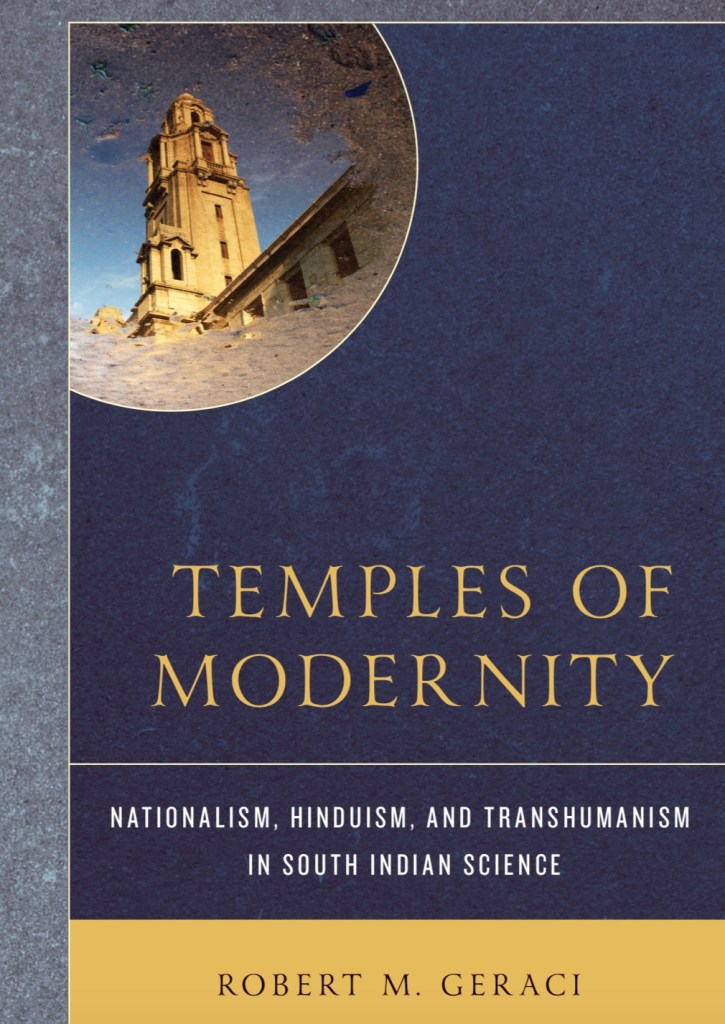
Anyway, I’ve witnessed folks trying to sort out the relationship between Hinduism and H+ recently, and that’s a bit amusing to me. When I wrote Temples of Modernity: Nationalism, Hinduism, and Transhumanism in South Indian Science (2018) there was someone (I forget who) that critiqued my chapter on H+ as basically being something I just arbitrary threw into the book. Well, of course it’s in the book because I am a recognized scholar on H+ but it’s also in the book because I saw something brewing when I lived in India to do the research (2012-13). I like to think I have some skill at observing the world around me. That book is godawful expensive and a devotee of a particular Hindu scholar posted a mean review on Amazon (LOL) but you can find a link here. At least I got nice endorsements from some really terrific scholars of S. Asia (Knut Jacobsen and Renny Thomas) and of the broader context of religion & science (Wim Drees, whose tenure as editor of Zygon: Journal of Religion & Science was a watershed time in our field)
Even fifteen years ago, groups like India Awakens and the India Future Society were trying to build something (I think IFS is defunct, but the brains behind IA, Nupur Munshi, is still working on such issues). And, as I noted through archival research in Futures of Artificial Intelligence: Perspectives from India and the U.S., there were actually folks connecting to Huxley and Haldane in the mid-20th century (though largely for non-H+ purposes). Anyway, back in the day Adam Buben and I were the only scholars taking H+ and Hinduism seriously but now that looks like a thing folks are doing. I don’t plan on trekking back to India to do more research (even though I had great experiences there when I lived in Bangalore in 2012-13 and 2018-19), but I hope other folks will engage and help us all learn.
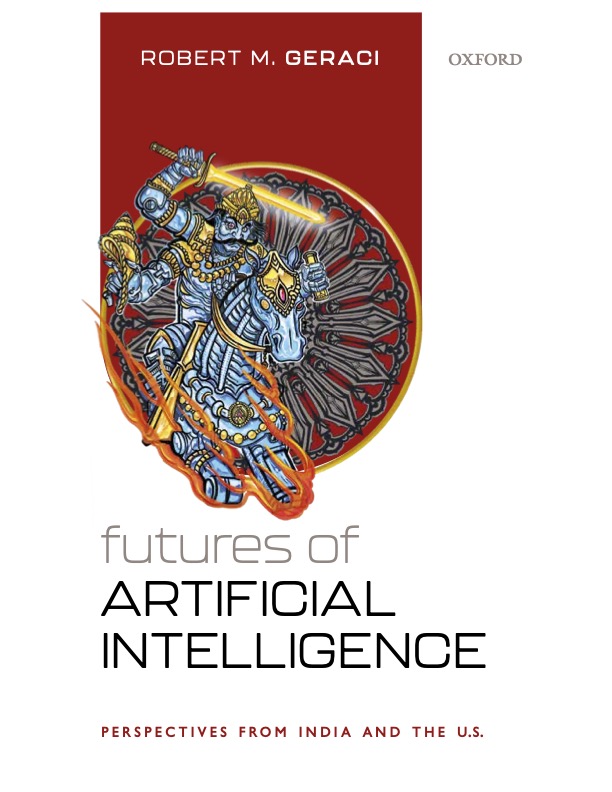
I should note that I’m awfully happy with both of those book covers. Temples has then-grad-student Chirantin Pramanik’s great photograph of the Main Building at the Indian Institute of Science reflected in water on the ground outside it, and Futures has a robot Kalki (the god who will come to end this world and begin the next) created by my tattoo artist, J.R. Maloney of Vanguard Tattoos in Nyack, NY.

