This started as a LinkedIn post.
I’ve had a truly enviable academic universe, with amazing people from before college, from college, from grad school, and from my the onset of my career — people who each found a way to make me a better man and a better scholar. This past week I lost the very closest of them, a man whose critical insight was always combined with a deep and abiding hospitality. Not just my life, but many, many lives were far better thanks to the character, wit, brilliance, and care of Stephen Kaplan. I won’t have enough lifetimes to thank him for believing in me and helping me be better at what I do.
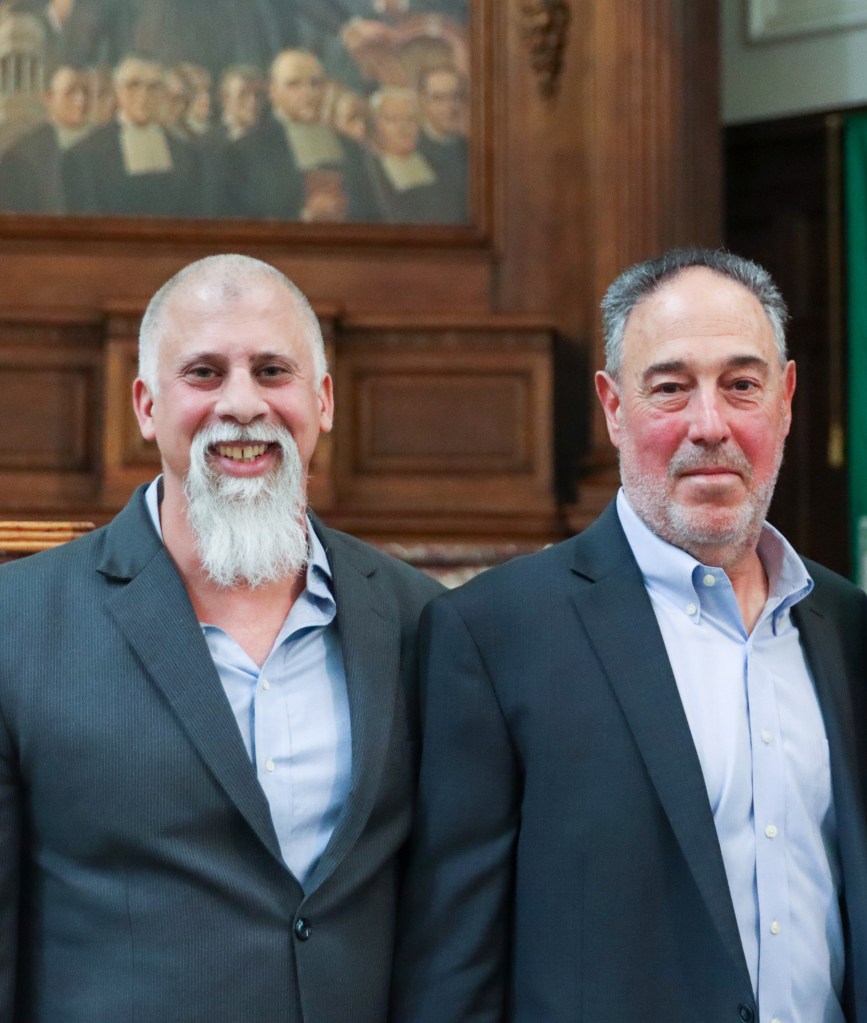
One of the best moments of my career was when he came to observe my teaching when I applied for full professor. It was a chance for him to see whatever growth I’d managed since I earned tenure. At the end of the class, he walked out with the students. I chatted with one or two who had questions. When I left the classroom, he was waiting for me in the hall and he wrapped me up in a great big bear hug. Years later, it was my privilege and joy to speak at the ceremony where he was awarded emeritus status upon his retirement, and this photograph was taken on that day. I was allowed 250 words or some nonsense. As I said then, “anyone who thinks that I’m going to stop at 250 words does not know me, and they certainly don’t know Steve Kaplan.”
Steve should be remembered for having given of himself in his community, in his work, and in his commitment to friends and family. He worked tirelessly to improve educational opportunities in the Bronx (e.g., founding the Jonas Bronck Academy). He built programs at Manhattan College also, from serving as a faculty leader for decades to creating the Center for Veteran Success (which became a thriving opportunity for student veterans, a model for thoughtful programs). He worked along other legendary faculty in the Department of Religious Studies, people I was lucky enough to join — he and Judith Plaskow and Claudia Setzer and Joe Fahey were staggering examples of what it could be to be a professor. It’s not just that Steve worked for a living (one of the highest compliments I can offer), he also worked to make the environment better. Whether that meant yoga retreats for veterans or hosting an off-campus dance — yes, a dance — for friends at the college and in the neighborhood or inviting people into his home for drinks and food (always either from Zabar’s or from down at Arthur Avenue), I don’t think I can imagine a world where Steve didn’t want everyone happy. He demanded much of those in his orbit, but that is because (ONE) he believed in their ability, (TWO) he was even more demanding on himself, and (THREE) he knew we could all be more if we just committed ourselves to it.
Steve never let me get away with anything. He would call me on bullshit (or just when he thought it was bullshit — some of that time I was right!). He would demand that I support any claim I made and expected that I would consistently give to the Department and the College. All this because he wanted to raise me up to be the best version of myself. He did that for everyone who would listen. I mean, sometimes it was hard to not listen — he could be very loud. But it’s one thing to listen and another to hear. But, yeah, he was loud and forceful. You had to push back. But in the midst of that high volume friction, something really great emerged.
Best of all, Steve was loud about his people. He loved his friends, his neighbors, and his family. I had the joy of teaching one of his children. I got to hear about his kids, his grandkids, his deep love for them and for his wife. He once told me that no matter how much my wife loved me, she could never do as well for me as his wife did for him. He appreciated her. He loved her. And it’s a good thing she is so amazing because that way she could tolerate what a pain in the ass he could be. In this, he and I have another thing in common — we both married very well indeed. He always enjoyed a chance to talk about his kids and his grandkids, and he was thrilled that his retirement meant he got to be with them so much more. If you wanted to see photos, he had an iPhone full of them ready-to-hand.
I’m still at a loss as to how to organize and write this…so I keep updating and editing.
Steve told me that when he wrote, he couldn’t go on to the next sentence until he perfected the sentence he was on. He needed the logic to be clear and precise, and you can’t get that if you aren’t quite sure what you’re trying to say. As in most things, he was methodical about his research. Early on, he wrote a book about comparative religion which challenged the idea that all religions are, at their root, the same thing. He figured they could be going in different directions and that might be okay and we could make that work intellectually and culturally. Later, he wrote a book about holography and religion. I think the book would have been more widely read if more people could have understood it. I say that in the same way that I mean Copernicus would have been more widely read if anyone understood him. Copernicus’s math was beyond almost all his contemporaries. Steve’s attention to scientific and religious concepts was deep, and following him down that path — one that includes the crazy science/technology of holograms and puts it in contact with Hindu concepts of cognition and perception — could be an intellectual challenge of the first order. He was creative enough to walk away from typical religious studies work on, for example, Hindu versions of rebirth and release and worry instead about whether Hindu understandings of human thinking could reveal interesting things to the world, especially when placed in conversation with contemporary physics/optics.
Toward the end of his career, Steve agreed to join me as coauthor on a paper I was working on. I knew it would be better with his contributions. But I also knew it would be a joy to do something together. He was one of three people to whom I dedicated Temples of Modernity so it was exciting to argue our way through a collaboration. I’m still not sure that I should have been the first author on the paper (we argued about that too). In the end, we never settled our biggest argument: we agreed that a machine could be “intelligent” but he insisted it could not be “conscious.” I stood by the fact that none of us really know how consciousness arises and that if it gets reborn then it might plausibly be reborn in a machine body if doing so would advance it’s spiritual ends. Of course, I don’t know if machines can have souls or whatever; but I don’t even know if we people have souls. The point was never who would be right (though I enjoyed every chance I got to tell him that someone — anyone — thought people could be reborn as machines in one of the dharmic religions); the point was we had fun. We had fun drinking and arguing with our old crowd of friends at Manhattan College. We had fun standing in the hallways outside our offices and arguing. We had fun living, working, and growing together.
And I got the better of that deal every time. For every little thing I might have given my friend, he probably returned it tenfold. For all my failings, I am wiser and better and more committed than I could have been without him in my life.
I’m so sad right now. But I’m also so grateful. Thank you, Steve. If you’re reborn as AI … let me know and we’ll find something new to argue about.

