So I’ve had a chance to post a couple of times about my new world at Knox College and I’ve been planning a third. The first post was sort of a general “what’s happened in my first year” and I followed that with a “how have I become a better scholar” post. Now it’s my chance to say a word or two about how amazing it is to teach in the Knox classroom. I’m excited to do this because I absolutely love teaching here. The students are creative, resilient, and committed to a better world. I talked about them in that first post. From in-class conversation to final projects, I get to see all manner of delightful student work. In addition, the College gives me extraordinary opportunities to share with my students. To illustrate how cool learning can be at Knox, I’m going to focus on my winter 2026 class on Religion, Science, & Technology.
I’ve been teaching that material for about 20 years. So, you probably think there isn’t much that would change when I move to a new institution.
It turns out that you’d be wrong.
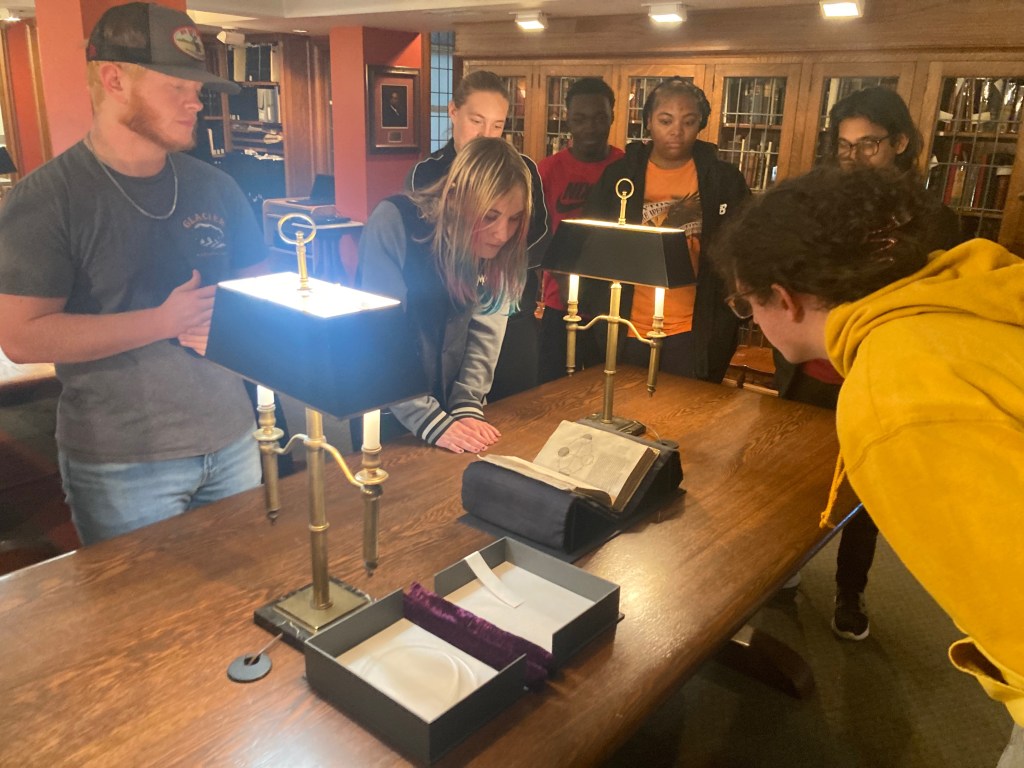
Because do you know what that is which my students are huddled around?
That is one of twelve existing first-edition copies of Galileo’s Dialogue Concerning the Two Chief World Systems (published in 1632). Not only does Knox have this remarkable treasure in its Special Collections, but we got to have it on display for our class. In addition, we had a slew of 1655 reprints of other Galileo works, including The Two New Sciences (orig. 1638) and Sidereus Nuncius (orig. 1610).
Who else gets to teach the Galileo Affair with 17th century manuscripts in the room?
And that’s not all!
Fast forward a week. I’m walking across our lovely campus, from my building on one side to the science building on the other. I tell my colleague that we’re going to be discussing the Scopes Trial in a couple of days.
Guess what I learned? Okay, you won’t.
He tells me that the Hunter of Hunter’s Civic Biology was a Knox professor!
So I knew that our library must have a copy of the textbook that was at the heart of the Scopes Trial in 1925. I reached out to the archivist and he shows up to my next class with a copy of Civic Biology from before the trial and a 1926 version from which the entire evolution chapter had been removed as part of the effort to sell more textbooks (because Scopes lost and the law remained for the next several decades).
And that’s not all!
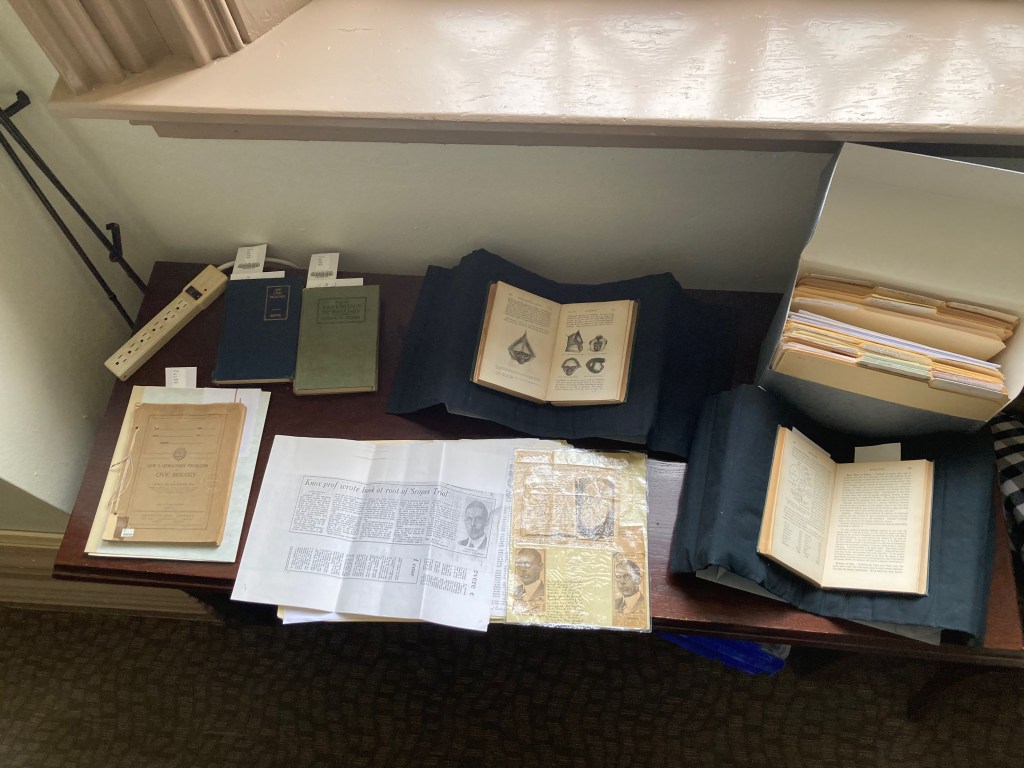
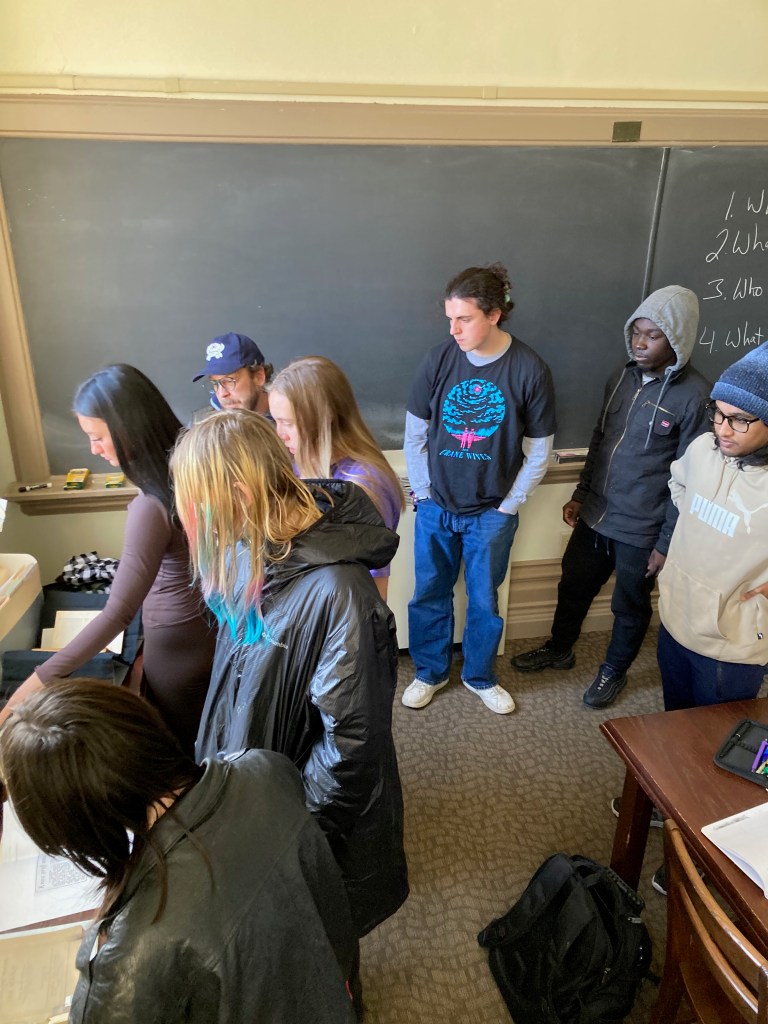
Not only did my students get to see the before and after versions of Civic Biology, they also got to see and handle a first edition of Charles Darwin’s Descent of Man (1871). Alas, we don’t have a first edition of On the Origin of Species, but this was still pretty awesome!
So the records of the history of two crucial moments in the study of religion and science — Galileo’s defense of a heliocentric universe and the debate over teaching evolution in US public schools — are right here at Knox College, allowing me to enrich my class with them.
Yeah, I’m telling you, this was the most awesome iteration of Religion, Science, and Technology I’ve taught.
Just a couple of weeks later, we had a distinguished visitor as part of my Robots, Rights, and Rites lecture series: Prof. Gabriele Trovato of Shibaura Institute of Technology in Japan. He’s the creator of SanTO, one of the world’s first robotic prayer aids (for which he was featured in just shy of a million news articles), and he’s been working on other robots since.
In addition to a packed public lecture, he was nice enough to come to class.
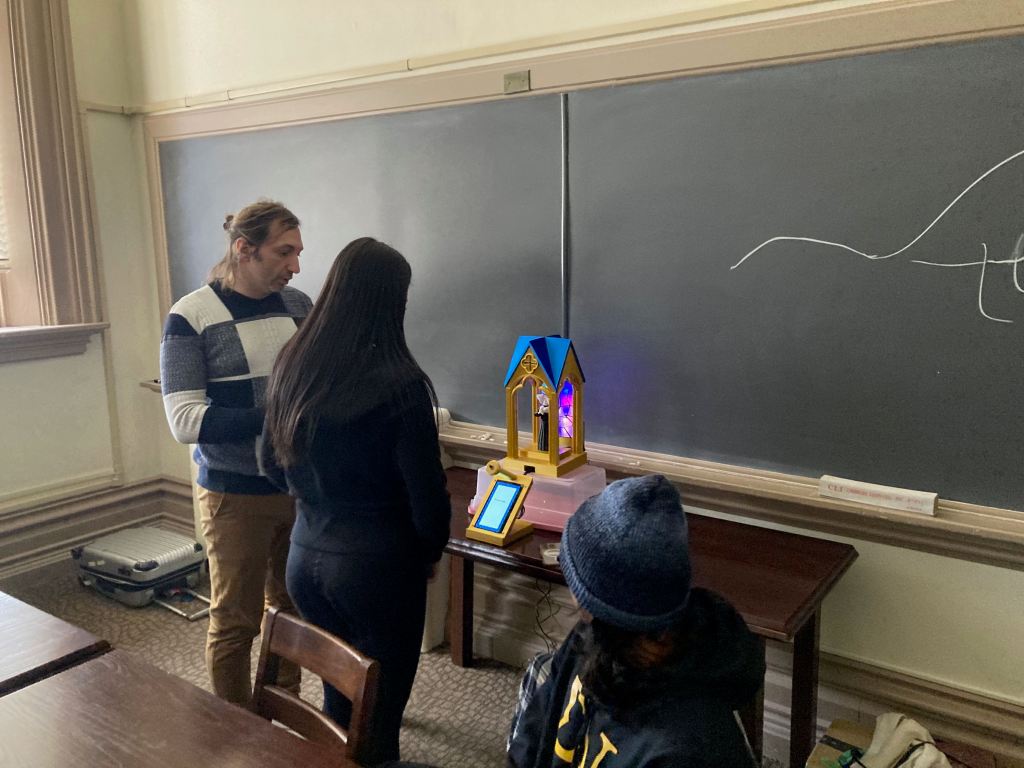
Here is Prof. Travoto introducing one of my students to his latest robot, ClémenCE, which creates a novel prayer when you tell it what you want it praying for and then repeats that prayer three times over the course of the next day.
ClémenCE is designed for operation in a hospital environment and Prof. Travato is interested in whether people will utilize such a tool and to what extent it creates comfort for them to do so.
These are events that would be singular highlights in a teaching career. But instead of just one chance, I get to return to the archival materials any time I want, and also to collaborate on other learning experiences with the folks in archives and special collections. On top of that, we have all manner of other amazing facilities and opportunities. For example, next year I hope to do some camping at the Green Oaks Field Research Center with my Religion and the Environment class.
Yeah. I like teaching here. Knox is truly a gem in the midwest, it is liberal arts education at its finest.
 Robert M Geraci