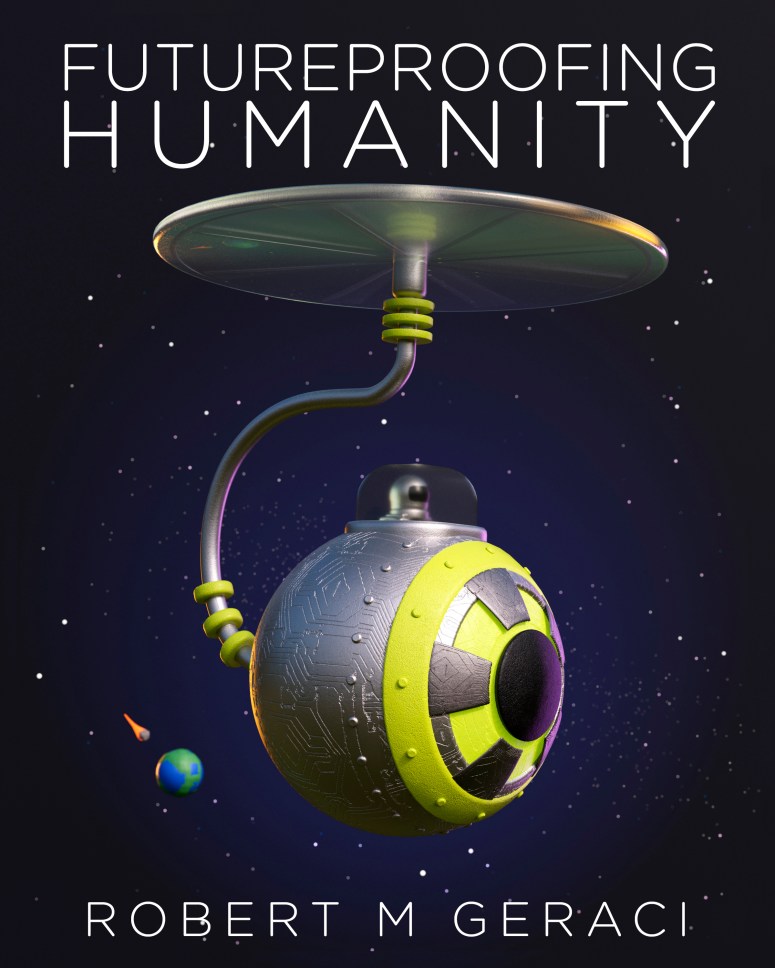
In my new book, Futureproofing Humanity (link tree to get it here), I explore how spaceflight is the culmination of both humanity’s need to protect civilization into the indefinite future and of a religion oriented around that idea. It would be fair to say that I’m basically part of that religion, but also fair to say that I don’t like the mainstream version of it. Well-known transhumanist and space scientist Giulio Prisco describes my position as “pushing the gas and brake pedals with the same foot at the same time!” To that, I replied, “It’s because there are two cars. One of them is full of clowns and should be slowed to a stop. There’s another car, harder to see, vague in outline, but which we need to find and ride to the next town.” While Prisco thinks the cars are too tightly connected to disambiguate them, I believe that a failure to do so will prevent our species from truly flourishing.
But one way or another, space stations are coming our way. In the book, I talk about the split between Gerard O’Neill’s dream of orbital space stations and the hope for terraforming, or at least occupying, the Moon, Mars, and beyond. O’Neill saw humanity creating habitats with gravity and replicating Earthly environments. Others, such as Robert Zubrin of the Mars Society, say that such habitats just don’t do enough to secure the future of the species.
O’Neill believed that with sufficient investment we could have built his large, rotating habitats by the year 2000. (side note: it’s funny how the arbitrary dates of our calendar affect people’s thinking…Turing said the same of machines that would be indistinguishable in conversation from human beings; Fuller said the same of teleportation; I’m sure I could gather other year 2000 predictions, including more obviously religious ones, but it’d sidetrack me)
Obviously, the year 2000 did not bring massive space stations full of human beings.
There has, however, been progress. Even as Elon Musk first declared — with his usual hyperbole, hubris, and high error rate — that he would have launched rockets toward Mars by the year 2026 (he has backtracked to the Moon and to data center space stations), there have been competitors and a variety of companies focused on space stations. Edd Grant details a few of the projects intended for 2026 in an essay on Singularity Hub. (another side note: if you’re not sure about the connections between the Singularity and space stations, you should definitely read my book)
One way or another, we will see a shift in how we occupy the space around Earth. Well, that or we will literally die trying. Our callous disregard for economic and environmental sustainability makes that option look entirely too likely.
I’m committed to the idea that human civilization is a beautiful thing and it’s worth protecting. I’m committed to the idea that our natural world is also beautiful and worth protecting. I hope we can find our way to both.
 Robert M Geraci