All right. We all know things have been crazy. You don’t have to agree with me about politics or the weather or anything else to agree that things have been crazy. We might disagree on why, but we’re on the same page about the fact that the world has been nuts.
About 9 months ago, I launched into a senior seminar on Religions of Spaceflight at my new academic home, Knox College. I had a blast. Terrific, fun students who worked like crazy. Often 100 pages per class session. Fun conversations. Knox College has awesome, interesting students and they made those classes an absolute joy as we worked our way through Jules Verne, the Apollo Project, Russian Cosmism, and western transhumanism.

But I have one regret: I thought about assigning one reading that, in retrospect, I didn’t. As part of the unit on Russian Cosmism we read some essays in Boris Groy’s wonderful book, but I did not have them read the essay by Alexander Chizhevsky.
Who cares? You might ask? Why worry about one more Russian Cosmist in the midst of so many interesting people? I had them read the original Cosmist, Fedorov, and his student Tsiolkovsky. We read Bogdonov.
But we didn’t read Chizhevsky.
I thought maybe I should have them read Chizhevsky and do some calculations. You see, Chizhevsky had a particularly entertaining idea — entertaining to me, anyway. He believed that solar energies affect human politics. That the height of solar activity corresponds to the height of human agitation. Good and bad.
He writes that “we must not dwell on the consideration of the significant quantity of materials gathered in research into the period of maximal excitability. Let us indicate just those decisive forces whose existence among the masses makes the emergence and development of these decisive events conditional upon itself: 1) The excitatory effect on the masses of the leaders of peoples, military figures, orators, the press, and so forth; 2) The excitatory effect of the moods and ideas circulating among the masses; 3) The rapidity of excitation from the unified psychic center; 4) The measure of territorial reach by a mass movement; 5) The integration and individualization of the masses. Never does the influence of leaders, military figures, orators, the press, and so forth reach such great heights as during the period of maximal charge from the activity of sunspots.”
So I considered having my students read Chizhevsky and then calculate the past 100 years of history and look for the heights of solar flares (which happen on eleven year cycles) and political agitation. Chizhevsky saw good and bad in political agitation. It wasn’t obvious that solar maximums would bring good or bad, just a lot of energy. He writes that “the period of maximal activity can also be called the period in which the face of the masses and the sound of the people’s voice are revealed. Historians reach an impasse on realizing that ideas about which people dared not speak just a year or two ago are now discussed openly and boldly; the masses grow more impatient, more restless, more excited; they begin to lift up their voices, to make demands, to take up arms. Demonstrations grow more malicious and unpleasant.” He goes on, but that probably suffices.
Short version: when there are lots of solar flares, people get emotionally charged. That can be good, but it can very definitely be bad.
So I thought about making my students map that out, but then I didn’t.
And then the summer came. And the fall came. And there were the northern lights even here in Illinois! Actually, they’d already begun in the fall of 2024. But by mid-2025, it seemed almost regular that the northern lights were visible far further south than typical. And it turns out, well, we’re living in one of those peak years. Lots of solar flares. Lots of political insanity. You and Mr. Chizhevsky can do the math together.
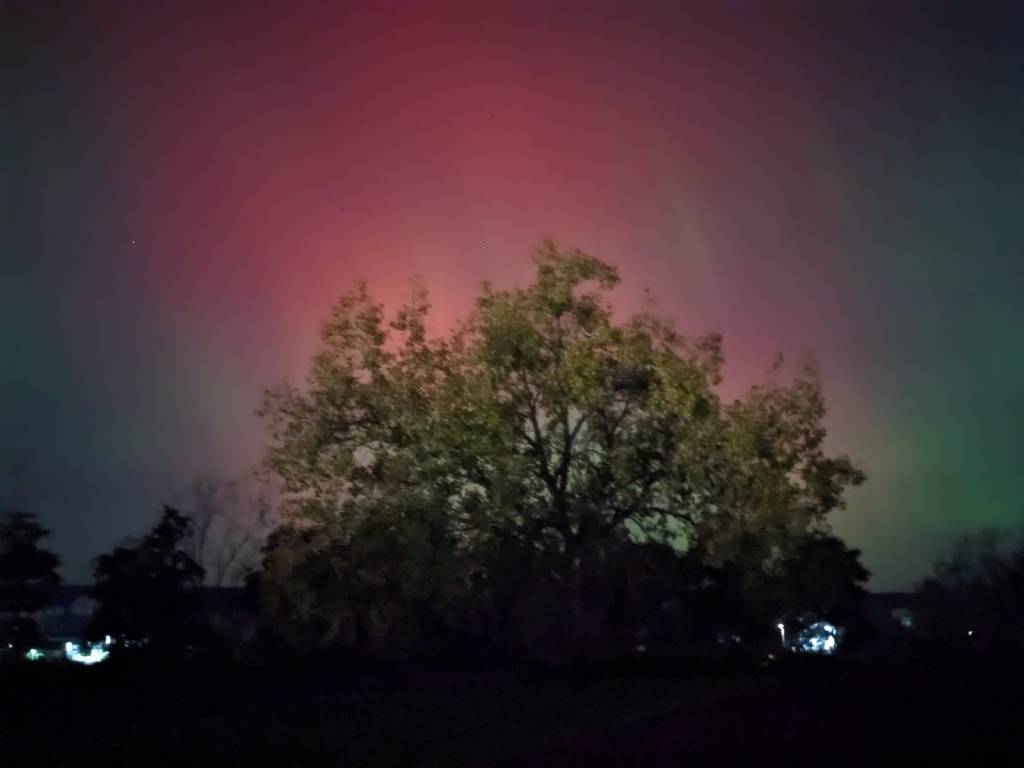
So here’s the good news: life should get better in 2026!
photo by courtesy of my son, taken in Geneseo, NY (Nov 2024)
 Robert M Geraci