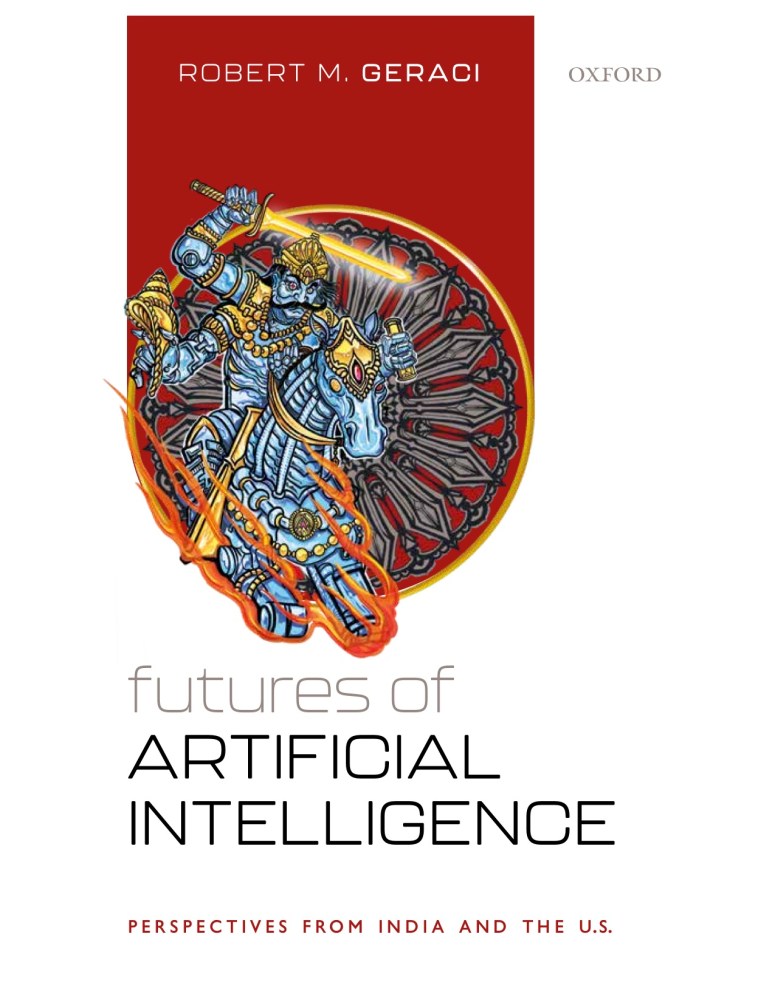
For a while now, I’ve been waiting for devout claims that Jesus will return as a robot (along with similar claims about the Islamic Mahdi). I’m not sure when I first predicted that the day would come, but by the time folks in India told me they thought that the god Kalki would come as AI it seemed inevitable. As I note in my most recent book, Futures of Artificial Intelligence: Perspectives from India and the U.S., and in a just-released collaborative essay in The Cambridge Companion to Religion and Artificial Intelligence, I’m not the only one hearing that about Kalki, and it’s not just students of tech and design who say so. My brilliant friend Holly Walters heard similar things from ascetic sages (it sure was nice of her to let me share her insights!).
So, what’s good for the goose is good for the gander. If Hindus can find their way to anticipate an eschatological AI, then so can other traditional religions. And while we’re at it, Masahiro Mori spawned a cottage industry of comments (including an early one from me) after his one-liner about how a robot could someday become a Buddha. It was a medium sized book, and that was the only sentence about AI enlightenment. But it was an exciting sentence!

Well, I still haven’t heard that Christians await a robot Jesus to inaugurate the Kingdom. But a church in Lucerne ran a two month experiment in which a confessional booth got transformed into a private conversation room where visitors could chat with a large language model Jesus. The Guardian ran a nice piece about it just this week.
Some folks already built an AI Jesus for Twitch, but this one is in a church.
The theologian in charge notes that some people thought Jesus gave them real insight and others were unimpressed. “The feedback suggested there had been a wide disparity in the avatar’s answers, said Schmid. “I have the impression that sometimes he was really very good and people were incredibly happy and surprised and inspired,” he said. “And then there were also moments where he was somehow not so good, maybe more superficial.””
It’s certainly possible that the AI Jesus gave some people quality dialogue and other times it was insipid, but I have another interpretation: the comments were almost always banal, but some people stoop to banalities and other people don’t. I won’t forget Jaron Lanier’s claim that we make ourselves stupid in order to make our technologies work…and then we suppose the tech is pretty smart. If you doubt him, just ask yourself how often Siri or Alexa or any other tech required that you repeat yourself, find simpler modes of expression, or otherwise bring yourself to its level. Obviously, people will do that in religious contexts also.
I’m further intrigued by the article’s closing: “Schmid said: “I think there is a thirst to talk with Jesus. People want to have an answer: they want words and to listen to what he’s saying. I think that’s one element of it. Then of course there’s the curiosity of it. They want to see what this is.”” Of course, the circus freak aspect of this seems only natural. I’d want to talk with the Jesus also (though I imagine the kinds of conversation I’d engage depart from those coming from the faithful). But I think a key issue here is Schmid’s recognition that people want to have someone tell them what to think and they are willing to have the AI be that someone. I confess that I find this worrisome.
 Robert M Geraci
One thought on “Mechanical messiah”